Taitotalo final project · 2026
From planning to a verifiable implementation
I designed, built and documented an IT laboratory for the fictional TuxAlfa organisation. The project brings together local servers, cloud management, network security and practical troubleshooting.
I handled architecture planning, virtual machine and service setup, permissions, functional testing and documentation. A simulated business let me investigate service dependencies without changing a real client's environment.
IT Support Technician qualification completed in October 2026.
Download the project brief (FI / EN / ES, PDF)- Virtual laboratoryFedora · KVM/QEMU · libvirt · Open vSwitch
- Network boundariesIPFire · Debian router · VLAN 30 / 40 / 60 · nftables
- Central servicesWindows Server 2025 · AD DS · DNS · DHCP · GPO
- Cloud management and monitoringEntra ID · Intune · Azure Arc · Zabbix · Wazuh
What I implemented
Networking and virtualisation
I built the virtual environment on a Fedora host. Open vSwitch connected the virtual networks, IPFire controlled external traffic and a Debian router handled connections between VLANs.
Identity and Windows services
I configured two domain controllers, AD DS, DNS, DHCP and Group Policy. File permissions, printing and software deployment were incorporated into central administration.
Hybrid and device management
I implemented Entra ID synchronisation, Hybrid Join and Intune enrolment. The documentation covers update rings, Delivery Optimization, Microsoft 365 application deployment and DC02 registration in Azure Arc.
Monitoring and protection
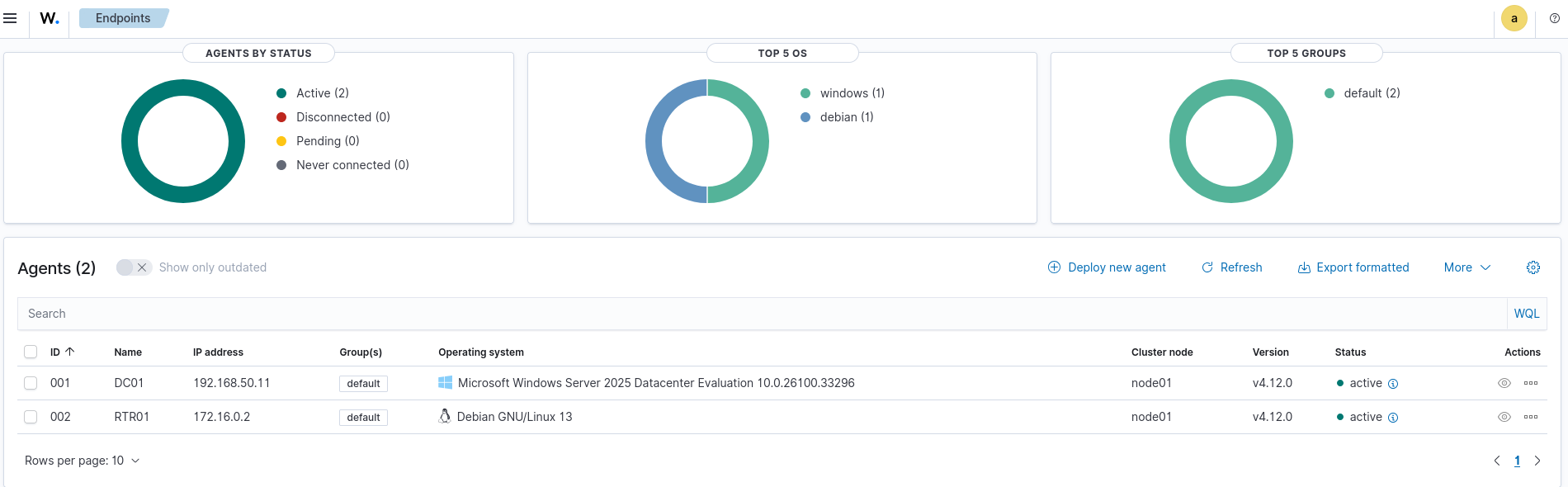
I deployed Zabbix and Wazuh servers in Azure. I documented host availability monitoring, Wazuh agents, vulnerability findings and the status of WithSecure endpoint protection.
How I checked the environment
- Compared blocked management connections from user networks with permitted connections from the IT network.
- Checked AD replication, DHCP configuration, DNS and the time hierarchy using service-specific tests.
- Checked Group Policy application, file permissions and centrally deployed software.
- Verified hybrid joining, Intune device enrolment and receipt of monitoring data.
Evidence from an actual test
Scope and further work
- This is an academic laboratory project, not a client production deployment or an independently audited security solution.
- Backup configuration was documented, but a completed restore test was not demonstrated.
- External WireGuard validation and FSRM email alerts remained further work.
- TLS for the Zabbix web interface and Wazuh SCA validation on RTR01 were not demonstrated. Production use would require separate hardening and testing.